Article Archives
- April 2026
- October 2025
- September 2025
- July 2025
- June 2025
- February 2025
- December 2024
- October 2024
- June 2024
- March 2024
- December 2023
- November 2023
- August 2023
- May 2023
- February 2023
- November 2022
- October 2022
- September 2022
- August 2022
- July 2022
- June 2022
- May 2022
- April 2022
- March 2022
- February 2022
- January 2022
- December 2021
- November 2021
- October 2021
- September 2021
- August 2021
- July 2021
- June 2021
- May 2021
- April 2021
- March 2021
- February 2021
- January 2021
- December 2020
- November 2020
- October 2020
- September 2020
- August 2020
- July 2020
- June 2020
- May 2020
- April 2020
- March 2020
- February 2020
- January 2020
- December 2019
- November 2019
- October 2019
- September 2019
- August 2019
- July 2019
- June 2019
- May 2019
- April 2019
- March 2019
- February 2019
- January 2019
- December 2018
- November 2018
- October 2018
- September 2018
- August 2018
- July 2018
- June 2018
- May 2018
- April 2018
- March 2018
- February 2018
- January 2018
- December 2017
- November 2017
- October 2017
- September 2017
- August 2017
- July 2017
- June 2017
- May 2017
- April 2017
- March 2017
- February 2017
- January 2017
- December 2016
- November 2016
- October 2016
- September 2016
- August 2016
- July 2016
- June 2016
- May 2016
- April 2016
- March 2016
- February 2016
- January 2016
- December 2015
- November 2015
- October 2015
- September 2015
- August 2015
- July 2015
- June 2015
- May 2015
- April 2015
- March 2015
- February 2015
- January 2015
- December 2014
- November 2014
- October 2014
- September 2014
- August 2014
- July 2014
- June 2014
- May 2014
- April 2014
- March 2014
- February 2014
- January 2014
- December 2013
- November 0019
- All Current Articles
Article Categories
- Announcement
- ASCE National
- ASCE Texas Section
- Awards
- Continuing Education
- E-Week
- Education Outreach
- Ethics Seminar
- Girl Scouts
- Institute Seminar
- Keynote Session
- Meeting Host
- Meeting Summary
- Membership Update
- President's Message
- Scholarships
- Technical Session
- Texas Section
- Volunteering
- Webinar
- Younger Members
- All Current Articles
Articles
CE Club August 2018 Update
Civil Engineering Club at Woodrow Wilson High School (2017-2018)
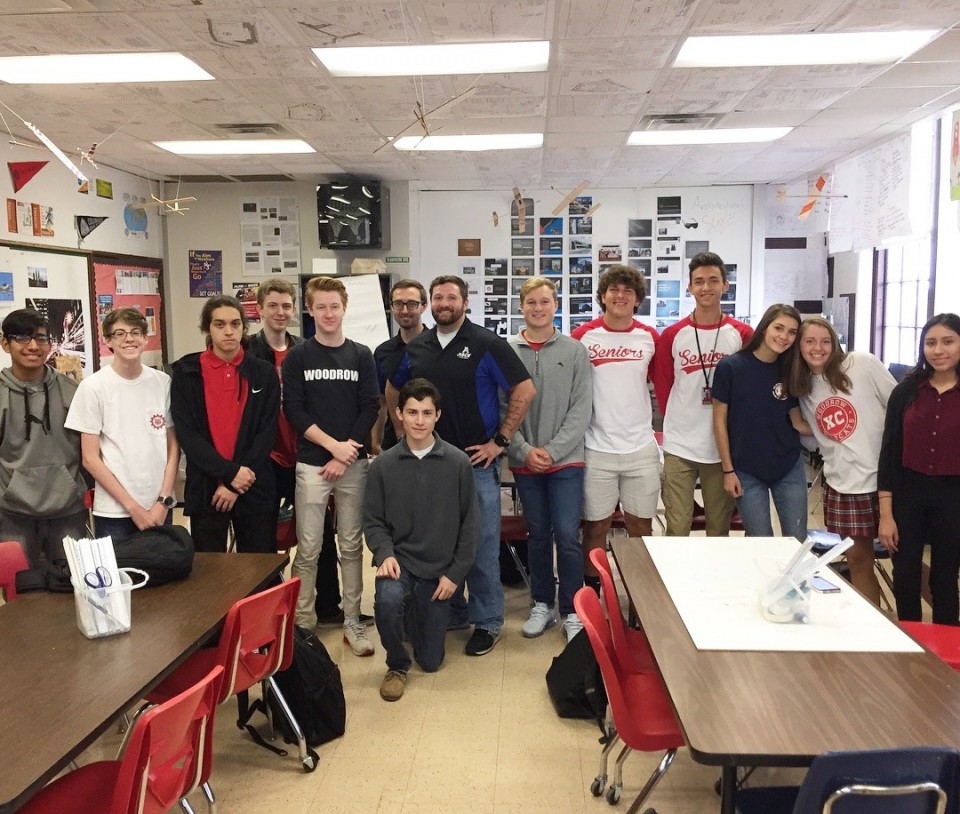
ASCE Dallas has grown the Civil Engineering Club at Woodrow Wilson High School in east Dallas from a handful of students after school to a full, in-class program that reaches 50-60 seniors and juniors. The Engineering Academy at Woodrow Wilson is sponsored by Project Lead the Way and led by Mr. Brandon Carver. Mr. Carver has been a key component to the success of the program by allowing ASCE Dallas CE Club Champion Jonathan Brower to coordinate speakers with his class curriculum. Guest speakers from all corners of the civil engineering industry were brought in to serve as substitute teaches for all three of the Civil Engineering and Architecture Design classes on a bi-weekly basis. Recaps from previous years can be found online here, here, here, and here. Below are summaries of all the guest speaker presentations from the 2017-2018 school year:
Civil Engineering Students from UT-Arlington
Two civil engineering students from  the UT-Arlington ASCE Student Chapter, Nick Sopko and AJ Czubai, opened up the 2017-2018 CE Club at Woodrow Wilson High School. They explained what it means to be an ASCE Student Chapter, including the steel bridge and concrete canoe competitions that their chapter fields every year. AJ walked the students through the typical class schedule flowchart that it takes to earn a degree in civil engineering from UT-Arlington. He also walked the students through a simple-span beam problem to give the high school students a taste of a college-level statics class.
Nick and AJ also took time to explain their backgrounds and share why they decided to study engineering. Their presentation was a great way to show the CE Club students how important ASCE as an organization can be to their development as a civil engineer if that is the career path they choose to take after high school.
Land Development with Foresite Group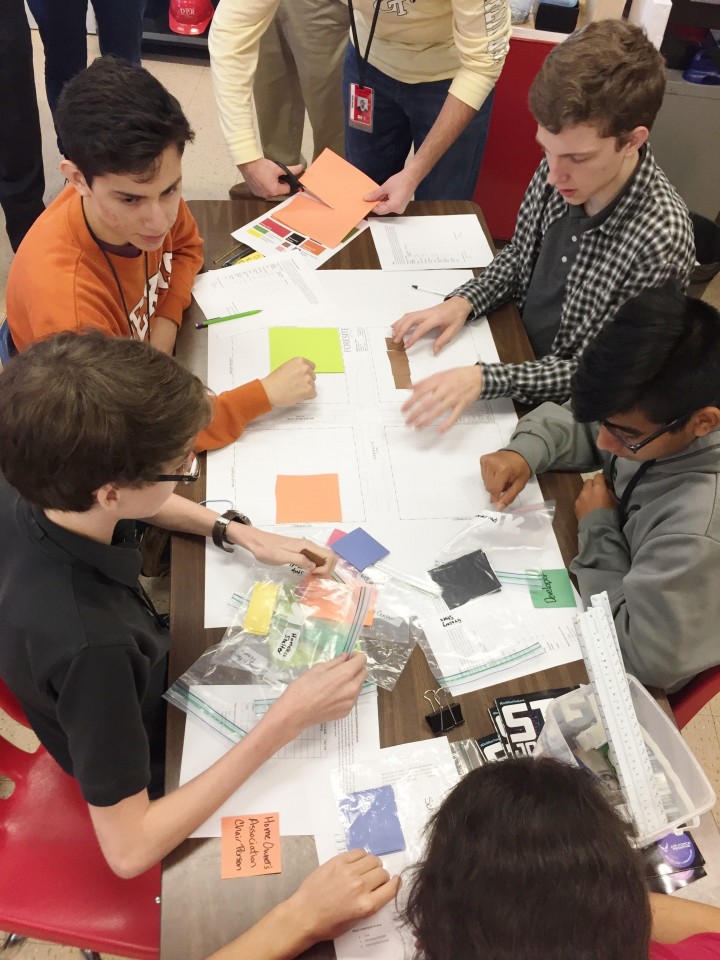
Julia Dang, Josh McNeill, Travis Pruett, and Brian Morris of Foresite Group, a loyal partner to the CE Club Program in Dallas, led their now famous land development activity with the Woodrow Wilson HS students. This great group activity illustrates to the high school students how land development teams must work together to achieve an under-budget, efficient, profitable, and welcoming community. Each student was given a specific role to personify on a development team:
- Developer – interested in getting the most return on investment
- Home Owner’s Association Chair – concerned with the long term residents of the community and the impact the development will have on property values, quality of life, and comfort
- City Planner – concerned about boosting the city’s economy while also meeting the community needs
- City Economic Developer – interested in the revenue the new development will generate and the jobs that will be created
- Mayor – up for re-election and interested in making the community members as happy as possible; gives the final approval of the layout

Students were given a site plan with four blank city blocks that was bordered by a neighborhood, a major highway, and commercial development. They were given a budget and a list of possible buildings and spaces that could fill up these four blocks, along with a cost associated with each building or space. Students then had to assume their roles within the development team to decide where and how many grocery stores, houses, apartment complexes, strips malls, pharmacies, parks, homeless shelters, schools, and community centers would be placed on the site plan. Students quickly realized the importance of patience and communication when each team member has a different agenda for the development. Each group then had to present their new development to the whole class while justifying the decisions they had made. The Foresite Group engineers then offered constructive feedback of each team’s development. Additional photos can be found online here.
Habitat for Humanity Build Day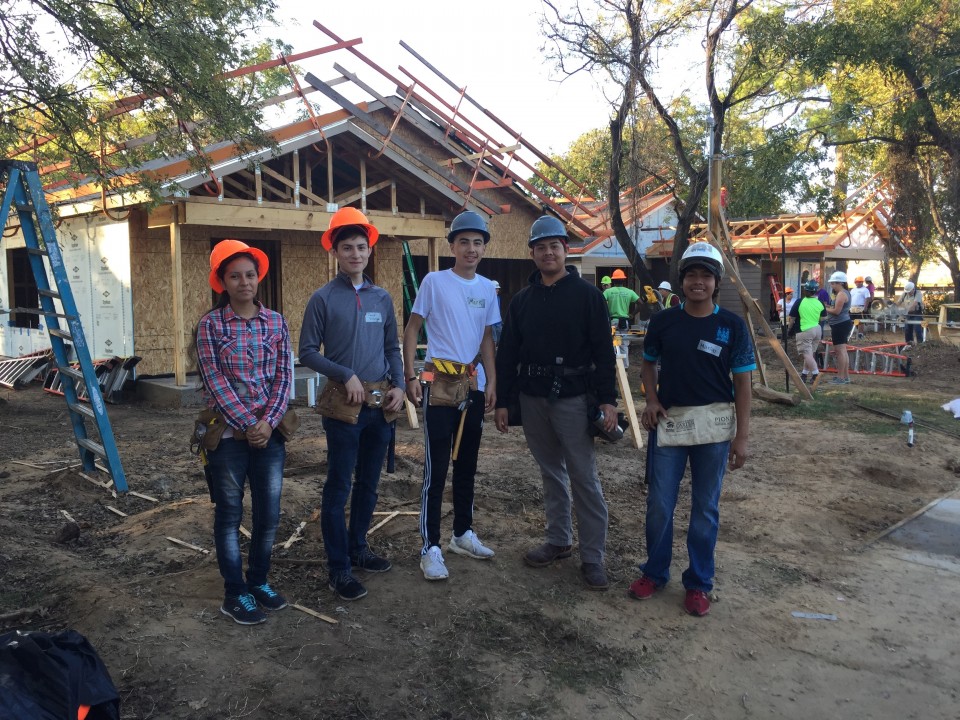
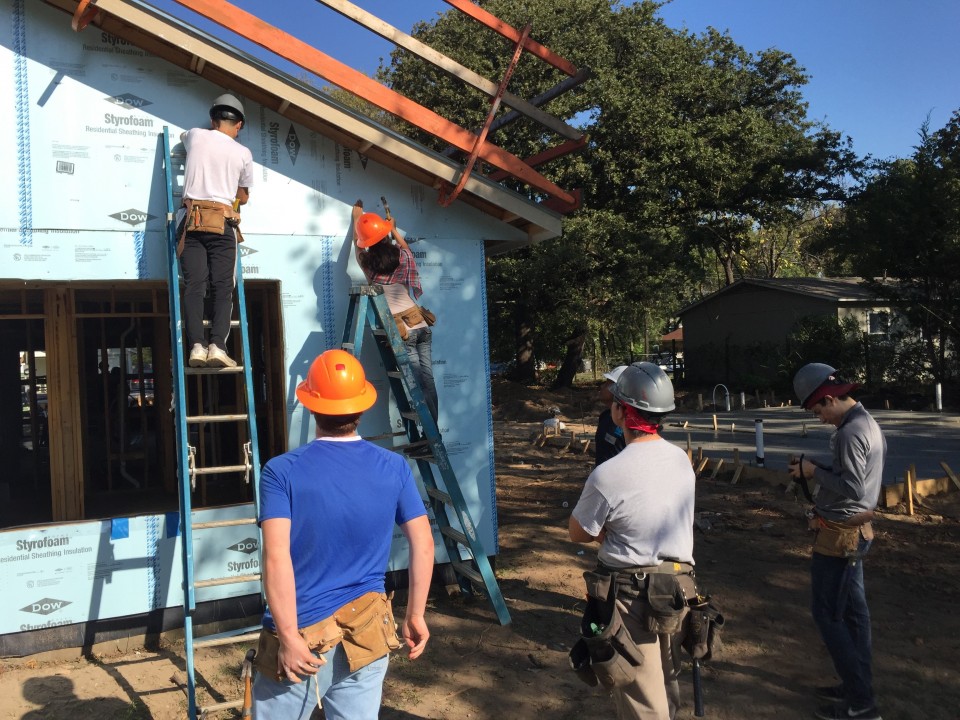
Ashlyn Kelbly, PE of Kimley-Horn, and a Habitat for Humanity Core Volunteer, helped organize a build day for the Woodrow Wilson CE Club students in south Dallas. Ashlyn and Jonathan Brower, ASCE Dallas Branch Director, volunteered from 8am to 3pm with the CE Club students nailing up foam board and siding all around a four bedroom house under construction. The students got to climb on ladders, cut foam board and siding panels, and do lots and lots of nailing!
At lunch time, the students asked lots of  questions about home construciton and how Ashlyn got involved with Habitat for Humanity to begin with. We hope to have another build day with more CE Club students in the spring!
Photos from the build day can be found online here.
Water Resources Engineering with LCA Environmental
 Mark Boyd of LCA Environmental, and the current ASCE Dallas Branch President, spoke to the CE Club students at Woodrow Wilson High School about water resources and environmental engineering. The discussion started off with a run through the water cycle, including evaporation, condensation, precipitation, groundwater, surface
  water, and surface run off. Mark then had the students consider surface run off specifically. They were asked to list off what could be contained in surface run off and how do engineers need to handle and treat that water.
Mark then had a great group activity for the students to perform an improptu water quality risk assessment. The classroom was split up into teams, and each team had to evaluate the purity of ten different water samples with varying levels of contamination. Some samples had obvious bits of dirt, particles, and oil floating in them, while others appeared to be perfectly clear and “clean”. The students were tasked with ranking the ten samples in order of their own concept of “cleanliness”. Afterwards, Mark would reveal to the students the true ranking of the samples based on mandated requirements for drinking water.
Additional photos from Mark’s presentation can be found online here.

Municipal Solid Waste with Parkhill, Smith, & Cooper
 Frank Pugsley of Parkhill, Smith, & Cooper is the ASCE Dallas Branch Past-President and came to talk to the WWHS CE Club for the second straight year. He first talked about his time in college where he earned a masters degree in environmental engineering through a five year program at Texas Tech University. Frank then told the students how he initially began his career in water treatment before transitioning into solid waste. Then, two years ago, Frank moved over to PSC and works with a team of 22 people on solid waste management.
So, what is municipal solid waste? Frank asked students to define this and to think about how their household trash gets from the curb that they drag it out to every week to the landfill. Frank compared the students’ definition of MSW to the state-adopted definition. He also showed the students what makes up municipal solid and how paper makes up the largest percentage followed by food, yard trimmings, plastics, and metals. The students also found it interesting that 60% of MSW is biodegradable. Next, the students were shown a diagram of the waste management cycle to illustrate the processes that civil engineers like Frank must consider, engineer, and develop systems and process for.
As a practical and specific example, Frank described the design and construction of landfills. He passed around a sample piece of a landfill liner and described all the different layers of a landfill, including the piping system to collect the students’ favorite word of the day: leachate. Frank also  showed students how landfills can be progressive and “green” by taking initiative to do things like burning off landfill-produced methane in turbines to produce electricity.
Finally, Frank challenged the students with an activity where they were given data relating to the landfill capacity in Houston area along with data about how much MSW was produced as a result of the cleanup and rebuilding of Houston in the wake of Hurricane Harvey. Students had to crunch the number themselves and decide on whether Houston has enough existing capacity to handle this sudden influx of MSW.
Structural Field Engineering with HILTI
 Alexis Clark, a structural field engineer with HILTI, shared her career with the WWHS CE Club. Alexis brought a unique perspective to the students in that while she has a degree in civil engineering from the University of Texas, she has the opportunity at HILTI to use her people skills more than a typical engineer and learn unique skills while working out in the field.
Alexis gave a brief overview of the history of HILTI and then took the students through a day in the life of a HILTI field engineer. She showed the students her bright red company car that also doubles as her office – again not something the typical engineer gets to have or experience! She then shared with the students how she consults design professionals on anchor design and selection, helps engineers and contractors with anchor specification and installation, and does a lot of on the spot problem solving that requires the analytical mindset she developed in college.
For a group activity, Alexis put together a hypothetical situation for the students where they had to choose between three different anchors types for a post installed connection situation. Alexis gave the students pros, cons, and pricing info about each anchor type and each team had to decide which anchor would be the best option for their situation. At the end of the class, each group had to stand up and give a brief presentation, justifying their anchor selection.

Volunteering with Habitat for Humanity
Ashlyn Morgan, a project engineer at Kimley-Horn and Core Volunteer for Dallas Habitat for Humanity, presented to the students at Woodrow Wilson on the inner-workings of the organization. Ashlyn explained how interested families can apply to become Habitat for Humanity homeowners and how Habitat is not simply “giving away” houses. The organization is primarily targeting families earning somewhere between 25%-60% of the area median income and requires the families to go through home ownership and mortgage classes in addition to putting “sweat equity” (or volunteered build hours) into their home.
The students were then shown some of the floor plans that Dallas Habitat for Humanity has available for the homes. There is also a variety of façade options for the houses, which is primarily the result of requests from the Dallas City Council to add some diversity to the Habitat for Humanity houses popping up in various neighborhoods.
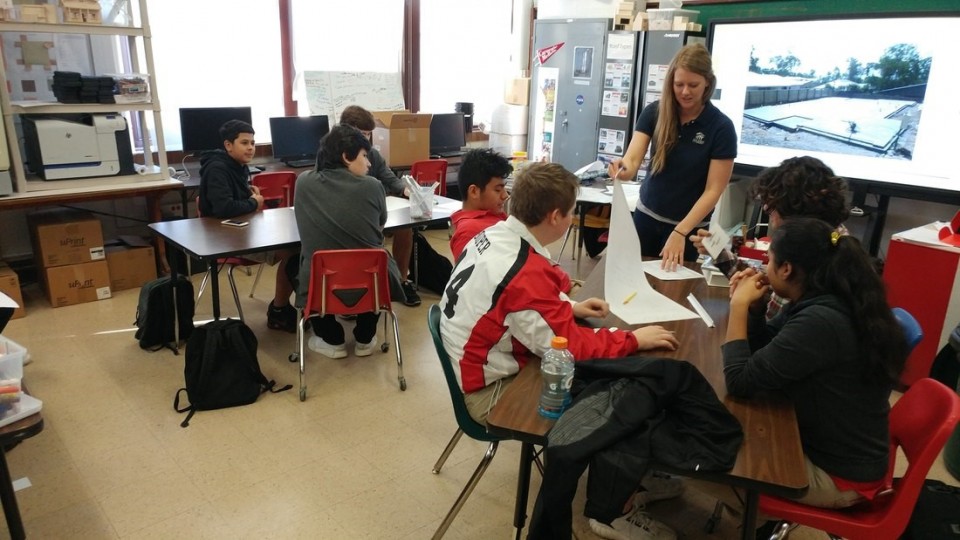
Ashlyn then asked the students to list off what they thought some of steps to building a home might be. Students mentioned important things such as lot size, soil conditions, surrounding area, trees, and wildlife. Ashlyn also explained how Habitat for Humanity has to do their due diligence to check the zoning requirements, flood plain status, access to public water utilities, and access to fire hydrants for the prospective house locations. Students were then given a large sheet of paper with a typical blank lot for them to develop their own house plan. Each team was given a different set of criteria ranging from ease of construction, maximizing floor space, and architectural features. Each group then presented their house plan design to the class and provided justification for their design. Additional photos can be found online here.
Materials Engineering with Wiss, Janey, Elstner Associates
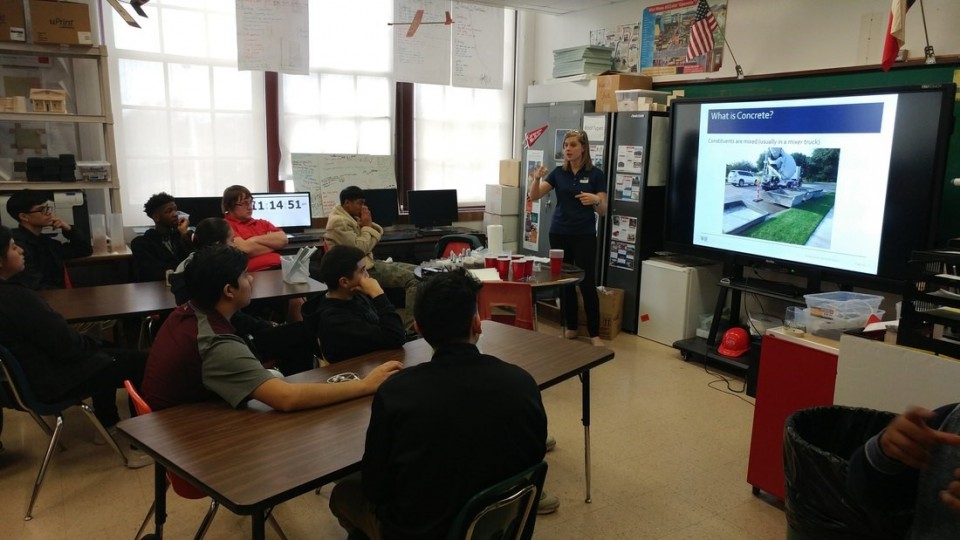
Kaitlin Forke and Doug Smith of WJE presented to the Woodrow Wilson High School CE  Club.The presentation was a brief overview of concrete including the basic constituents (with specific focus on Portland cement and chemical admixtures), the batching process, and field placement and testing. The presentation included an activity that highlighted the effects of chemical admixtures, specifically super plasticizers and viscosity modifying admixtures (VMAs), on the rheology of a concrete mix. During the activity, each student mixed Portland cement and water in a small container. After seeing how difficult it was to mix just the cement and water, they added a few drops of super plasticizer and were able to see a drastic improvement in workability. However, when they placed a
  few aggregates in the mix (small pebbles), all the aggregate sank to the bottom. Next they added a few drops of VMA to their mixes and didn’t see any drastic changes in workability. However, when they placed aggregates in the mix, the aggregate stayed on top initially and could be evenly distributed by mixing.
Additional photos can be found online here.
Structural Engineering with L.A. Fuess Partners
Phillip Pesek of L.A. Fuess Partners gave the CE Club students at Woodrow Wilson H igh School and overview of structural engineering just in time for Mr. Carver to start covering the structures cirriculum in their classroom. Students were challenged to consider the structures that are all around them: from buildings and bridges to even things like cars, airplanes, and roller coasters.
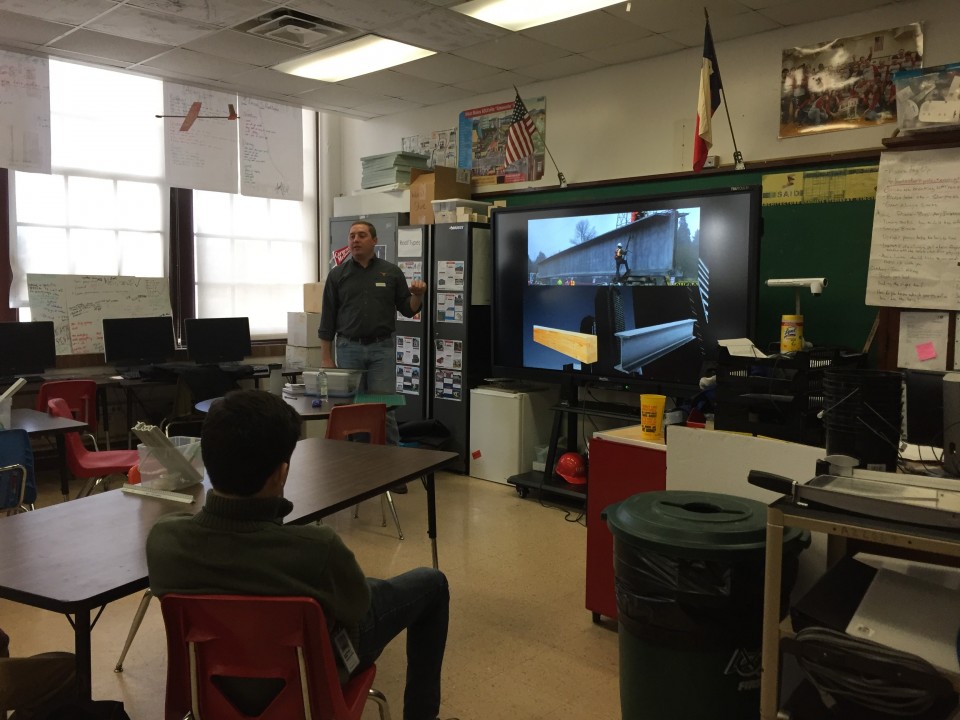
Phil then took the students through the basics of the engineering design process of analysis, design, and iteration. He explained how engineers analyze and predict loads, material properties, and architectural needs to then design structural elements like slabs, beams, columns, foundations, and lateral elements.
Finally, Phil explained how structural engineers have to design for both strength AND serviceability. To illustrate this process, he presented the students with a simply supported beam problem and had the students work out both strength and deflection equations with varying material properties.
Earthquake Engineering with L.A. Fuess Partners
Steven Blair and Nick Prather, engineers from L.A. Fuess Partners, capped off the second of two presentations by the Uptown Dallas structural engineering firm. Steven opened the presentation up with a brief overview of different lateral force resistance systems, including: braced frames, shear walls, and moment frames. The students were also taught the strength of triangles when it comes to braced frame design.
 Next, Nick went over the design challenge: building earthquake-resistant structures out of marshmallows, gum drops, and spaghetti sticks. The marshmallows simulated "pinned" connections, while the gum drops simulated "fixed" or moment connections. The students were also given design criteria with regards to footprint size, minimum number of stories, and story height. Once the students had built their spaghetti stick structures, Nick and Steven tested them on shake tables with varying intensity and orientations. Lateral force resisting elements in each structure were then broken slowly and the students were asked to guess how building performance would be impacted.
Additional photos from this activity can be found online here.
Civil Engineering Students from SMU
Several students from the ASCE SMU Student Chapter kicked off the new Civil Engineering Club at Hillcrest High School with a presentation on what a college civil engineering program looks like. The SMU students shared a lot about the college application and scholarship process and how the engineering school at SMU functions. The SMU students also showcased all the different career options that are possible with a degree in civil engineering including examples of major civil engineering projects that most of the students recognized.
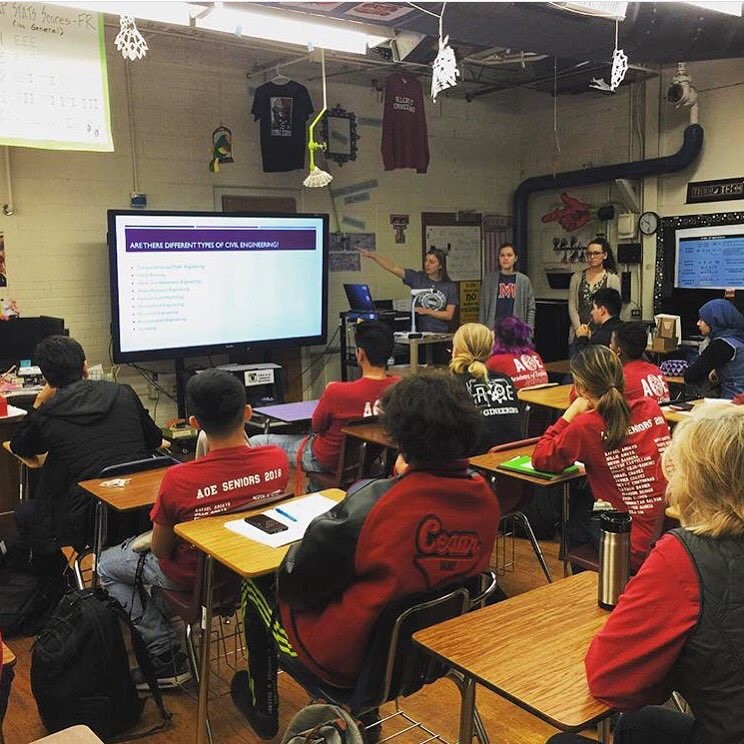
The SMU students also went into detail on their senior design projects. The high school students from Hillcrest High School especially enjoyed getting to ask specific questions about the unique challenges and experiences of studying civil engineering in college.
Construction Engineering with L.A. Fuess Partners
Jonathan Brower of L.A. Fuess Partners presented to the Hillcrest HS CE Club on how his job as a structural engineer not only involves structural design using math and physics but also large amounts of time on coordination and administrative duties with architects and contractors. All this communication must be done in a formal and professional manner while dealing with others that are just as busy with other concerns, priorities, and projects.
To help illustrate this challenge, the students were given different packets of pictures of LEGO buildings made from a variety of LEGO blocks of different colors and sizes. The LEGO blocks to each building were given to one of the other groups in the room. Each team of students had to then figure out the most efficient way to communicate how to build their LEGO building using only pencil and paper. Each team was responsible for producing a set of design drawings for a building as well as constructing a LEGO building from the design drawings of another team. The teams could ask questions back and forth with the other design or construction teams they were working with, but everything had to be communicated “officially” on paper, meaning no talking between teams was allowed.
Students gained a special appreciation for the coordination and multitasking that being an engineer requires as they began to receive construction documents for building a LEGO structure while they were receiving questions and RFIs from the team that had their construction documents.
Traffic and Transportation Engineering with Urban Engineers Group
Omar Venzor of Urban Engineers Group talked with the CE Club students about traffic engineering. He outlined what it takes to become a traffic engineer, including the licensing requirements. Students were also shown that they could work for either public organizations such as cities, counties, airports, and TxDOT or private corporations that do consulting work.
Next, Omar explained the types of projects that traffic engineers work on. The students were shown the reports that are produced from traffic studies that determine the existing conditions and capacity at a location, as well as future analysis to determine what improvements should be made to achieve a prescribed level of service. They also discussed signal timing, signing, and pavement marking design, ITS design, and roadway illumination. The students then participated in an activity where they could design their own traffic control plans.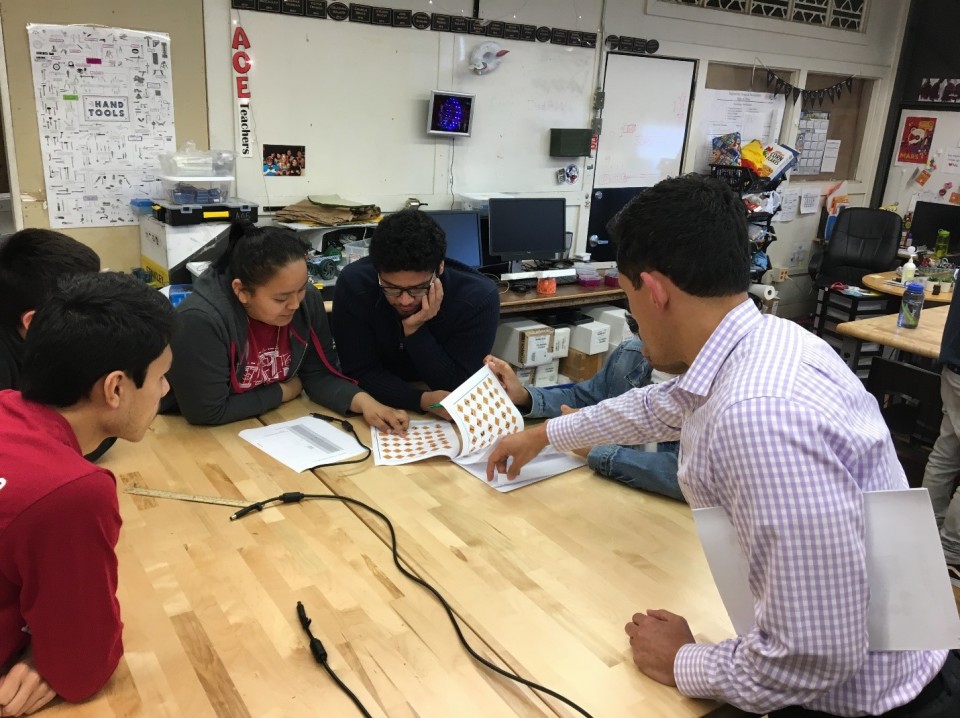
Land Development with Pape-Dawson Engineers
Fernando Ceballos of Pape-Dawson Engineers spoke to the Woodrow Wilson High School CE Club about land development for the second straight year. He asked the students what their concept of zoning was and filled in the gaps for them. He explained that as a land development engineer his job is to help owners and developers determine if construction is possible on a site they may own or are considering purchasing. The sites are constrained by things like creeks, flood plains, endangered species, rocks, water, gas lines, topography, and many other things.
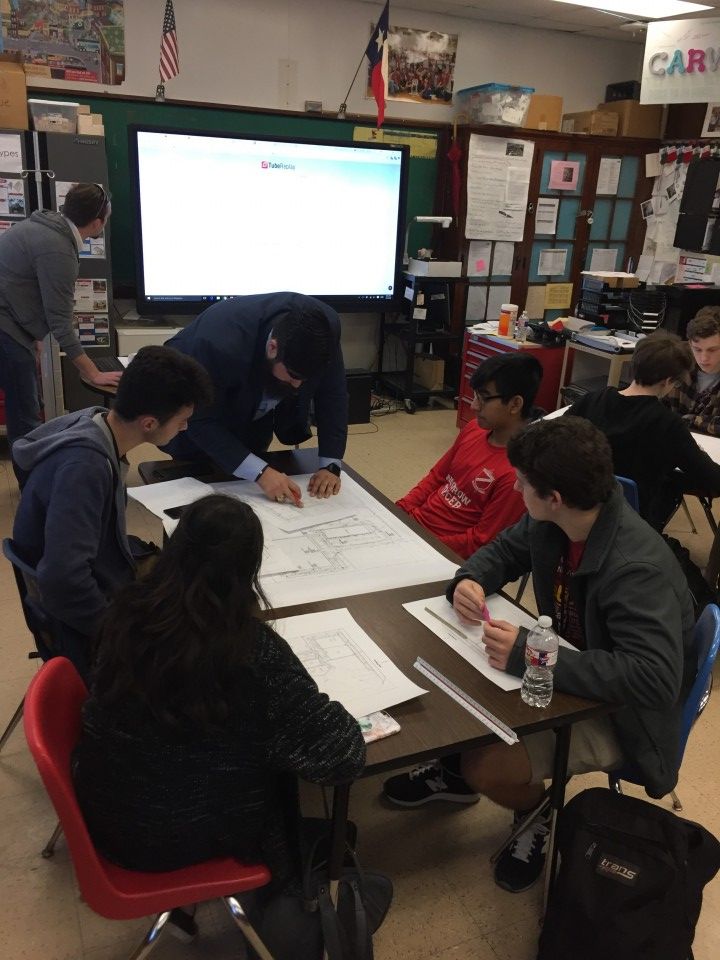
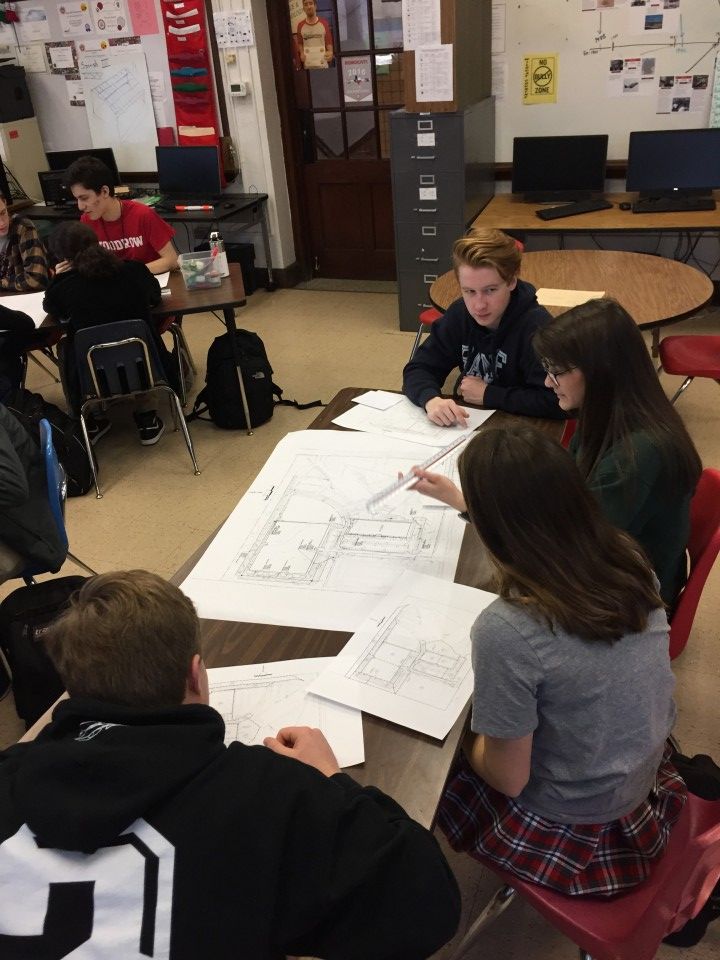
For a group activity, the students were given a commercial land plot with drainage areas marked out on plan. They were given equations to help calculate the total flow capacity of different sized pipes based on diameter, roughness, and length. Each team had to use their civil scales to determine the most cost-effective pipe system to drain the commercial land plot they were given. The team with the best design at the end of all three class periods was then awarded gift cards!
Water Resources Engineering with Kimley-Horn

Ashlyn Morgan of Kimley-Horn spoke to the Hillcrest High School CE Club about water and wastewater utilities. She discussed rehabilitation projects she is currently working on in Dallas, including trenchless rehab methods. She also shared some brand-new projects she’s been working on, including a new pump station in western Flower Mound.
Ashlyn also led a great group activity on water master planning. The classroom was split up into teams and each group was given three regions of a town with specified water demands. The students had to pick pumps and pipe sizes so that water could efficiently get to all three regions. Each pump and pipe type also had an associate cost along with its capacity. This helped teach the students about optimization and challenged them to find the most economical solution.
MEP Engineering with Stantec
Priscilla Maya, a mechanical engineer at Stantec, gave the Woodrow Wilson CE Club students a presentation on MEP systems within the built environment. She showed them illustrations of how heating, ventilation, and air conditioning systems are set up in buildings just like the school they walk into every day. She even pointed out the different elements of the heating and air conditioning system in Mr. Carver's classroom such as the thermostat and ceiling diffusers. The students were also shown how to calculate the "load" in a building from the perspective of an MEP engineer. The building skin, interior partitions, occupants, and equipment such as computers and machinery all affect how an interior space must be conditioned and ventilated. The students were asked to consider the "load" in their classroom and how this could affect the design and performance of the school's mechanical systems. 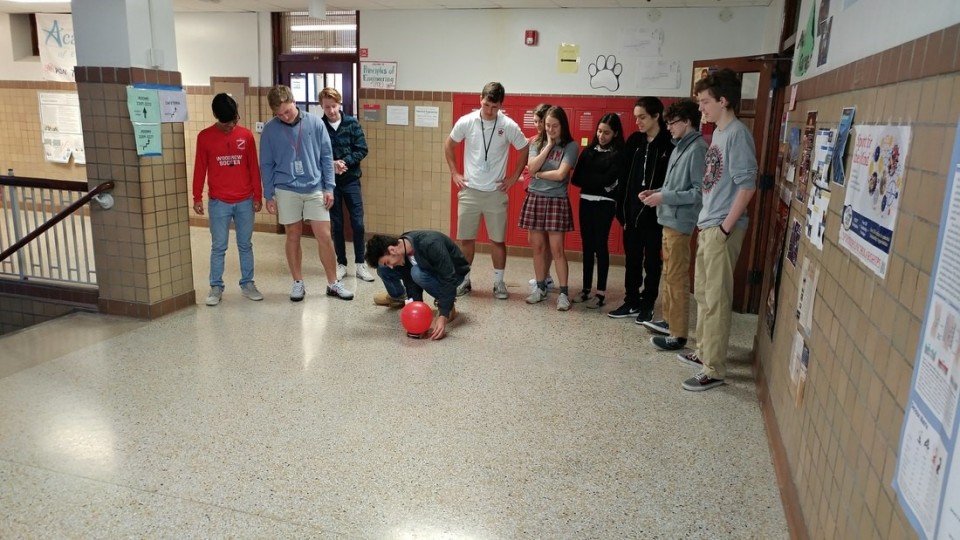
 The students were very impressed that some of the terminology and equations used in their class curriculum were used by Priscilla in her daily work as an MEP engineer. This direct connection between the concepts learned in class and the practical application by a "real-life" engineer are a great encouragement and motivation for the students in Mr. Carver's classes.
The students then put these concepts and theories to work, collaborating in teams to design a balloon race car out of foam core board, cardboard, dowels, and plastic straws. The greatest challenge was to maximize the thrust out of one or multiple straws to make their race car go the farthest. Additional photos can be found online here.
Water Resources with BGE Inc
Heidi Fischer of BGE Inc spoke to the Woodrow Wilson High School CE Club about her career in water resources engineering. She broke down the structure of water resources into three categories:
- Hydrology – how much water we have/get
- Drainage – where does all that water go?
- Hydraulics – how we move and control water through pipes and channels
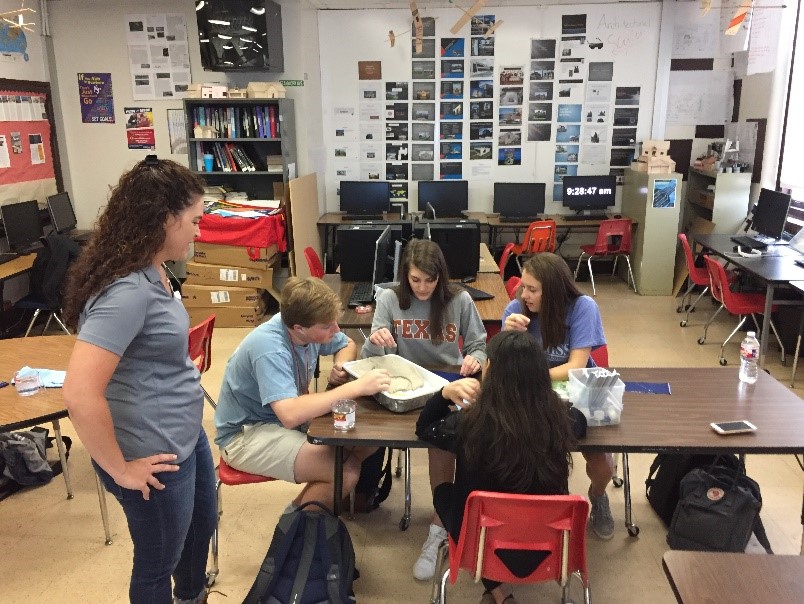
Heidi explained to the students that she makes floodplain impact studies to help other engineers know how high to build their bridges, help developers determine where they can construct new buildings, and help others develop erosion control methods. She took the students through a day in her life at work, which includes field visits, computer modeling, report writing, client meetings, design calculations, and RFI responses. As a practical example she showed the students some models and pictures fo the Crooks Branch Project she worked on for DART.
Finally, she challenged the students with a “build your own floodplain” activity where students were given a blank hill of clay along with tools and materials to make their own unique
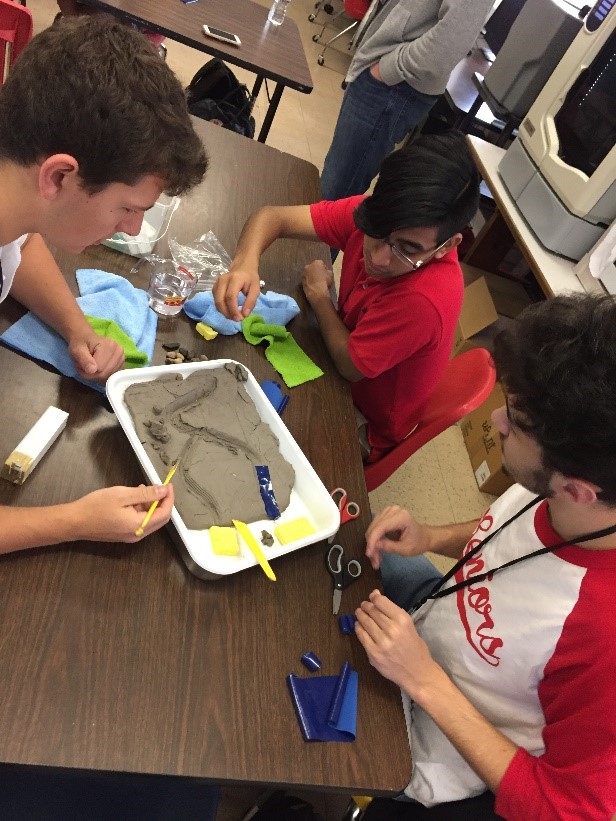
hillside with varying terrain, topography, and surfact textures. The students then poured water down the hillsides to see how the water flow was impacted. Additional photos can be found online here.
CE Club Field Trip with L.A. Fuess, ASCE Dallas, and Hilti
Continuing with the annual tradition, the ASCE Dallas Younger Members hosted the Woodrow Wilson CE Club on an all-day field trip on Monday, May 14th. Ten of the highest performing students from the Civil Engineering and Architecture Design classes at WWHS participated in the field trip along with their teacher, Mr. Brandon Carver.
The day started off on the construction site of Ventana by Buckner, a project on which L.A. Fuess Partners served as the structural engineering consultant. Jonathan Brower and Brian Schnittker of L.A. Fuess walked the students through the job site with the help of a couple of contractors from Whiting-Turner. The group was also joined on this site visit with ASCE President-Elect Robin Kemper and ASCE Texas Section Executive Director Lindsay O’Leary who were both in town for a series of events in DFW scheduled as part of Infrastructure Week 2018. Students were shown the pan-joist construction on the first two garage levels of the building and then taken up to the higher levels that were designed as two-way, flat-plate PT slabs. Jonathan and Brian showed the students the ins and outs of post-tensioned construction while also answering all the great questions the students asked about all the construction going on around them.
From there, the students traveled up north to the ASCE Dallas Branch Luncheon. The students were treated just like civil engineering professionals and were given name tags and special reserved seating close to the front of the room with some ASCE Dallas Younger Members. At the luncheon, they got to watch the installment of new Life Members and listen to a great presentation on the state of the DFW Airport infrastructure by Mr. Khaled Naja.
Finally, the students traveled to the Hilti Research and Development Facility in Irving to meet up with Alexis Clark of Hilti and the Fort Worth Branch.  They were taken on a tour of the testing facilities with Hilti Engineer Frank McMahon who introduced the students to the types and roles of engineers working at Hilti along with some current projects. Frank showed the students the testing facilities where they got to see direct fastening for steel-to-steel connections, concrete anchor testing, and fire stop testing with a burn room simulation! Alexis also took the students through the Customer Experience Center to check out drills, anchors, and other Hilti tools in person. At the end of the tour, they met the manager of the Fire Protection Engineering group, Foster Cryer, who discussed the need for fire protection systems and the testing that goes into them.
Additional photos from the students’ all-day field trip can be found online here, here, and here.

