Article Archives
- April 2026
- October 2025
- September 2025
- July 2025
- June 2025
- February 2025
- December 2024
- October 2024
- June 2024
- March 2024
- December 2023
- November 2023
- August 2023
- May 2023
- February 2023
- November 2022
- October 2022
- September 2022
- August 2022
- July 2022
- June 2022
- May 2022
- April 2022
- March 2022
- February 2022
- January 2022
- December 2021
- November 2021
- October 2021
- September 2021
- August 2021
- July 2021
- June 2021
- May 2021
- April 2021
- March 2021
- February 2021
- January 2021
- December 2020
- November 2020
- October 2020
- September 2020
- August 2020
- July 2020
- June 2020
- May 2020
- April 2020
- March 2020
- February 2020
- January 2020
- December 2019
- November 2019
- October 2019
- September 2019
- August 2019
- July 2019
- June 2019
- May 2019
- April 2019
- March 2019
- February 2019
- January 2019
- December 2018
- November 2018
- October 2018
- September 2018
- August 2018
- July 2018
- June 2018
- May 2018
- April 2018
- March 2018
- February 2018
- January 2018
- December 2017
- November 2017
- October 2017
- September 2017
- August 2017
- July 2017
- June 2017
- May 2017
- April 2017
- March 2017
- February 2017
- January 2017
- December 2016
- November 2016
- October 2016
- September 2016
- August 2016
- July 2016
- June 2016
- May 2016
- April 2016
- March 2016
- February 2016
- January 2016
- December 2015
- November 2015
- October 2015
- September 2015
- August 2015
- July 2015
- June 2015
- May 2015
- April 2015
- March 2015
- February 2015
- January 2015
- December 2014
- November 2014
- October 2014
- September 2014
- August 2014
- July 2014
- June 2014
- May 2014
- April 2014
- March 2014
- February 2014
- January 2014
- December 2013
- November 0019
- All Current Articles
Article Categories
- Announcement
- ASCE National
- ASCE Texas Section
- Awards
- Continuing Education
- E-Week
- Education Outreach
- Ethics Seminar
- Girl Scouts
- Institute Seminar
- Keynote Session
- Meeting Host
- Meeting Summary
- Membership Update
- President's Message
- Scholarships
- Technical Session
- Texas Section
- Volunteering
- Webinar
- Younger Members
- All Current Articles
Articles
CE Club May 2018 Update
Water Resources Engineering with Kimley-Horn

Ashlyn Morgan of Kimley-Horn spoke to the Hillcrest High School CE Club about water and wastewater utilities. She discussed rehabilitation projects she is currently working on in Dallas, including trenchless rehab methods. She also shared some brand-new projects she’s been working on, including a new pump station in western Flower Mound.
Ashlyn also led a great group activity on water master planning. The classroom was split up into teams and each group was given three regions of a town with specified water demands. The students had to pick pumps and pipe sizes so that water could efficiently get to all three regions. Each pump and pipe type also had an associate cost along with its capacity. This helped teach the students about optimization and challenged them to find the most economical solution.
MEP Engineering with Stantec
Priscilla Maya, a mechanical engineer at Stantec, gave the Woodrow Wilson CE Club students a presentation on MEP systems within the built environment. She showed them illustrations of how heating, ventilation, and air conditioning systems are set up in buildings just like the school they walk into every day. She even pointed out the different elements of the heating and air conditioning system in Mr. Carver's classroom such as the thermostat and ceiling diffusers. The students were also shown how to calculate the "load" in a building from the perspective of an MEP engineer. The building skin, interior partitions, occupants, and equipment such as computers and machinery all affect how an interior space must be conditioned and ventilated. The students were asked to consider the "load" in their classroom and how this could affect the design and performance of the school's mechanical systems. 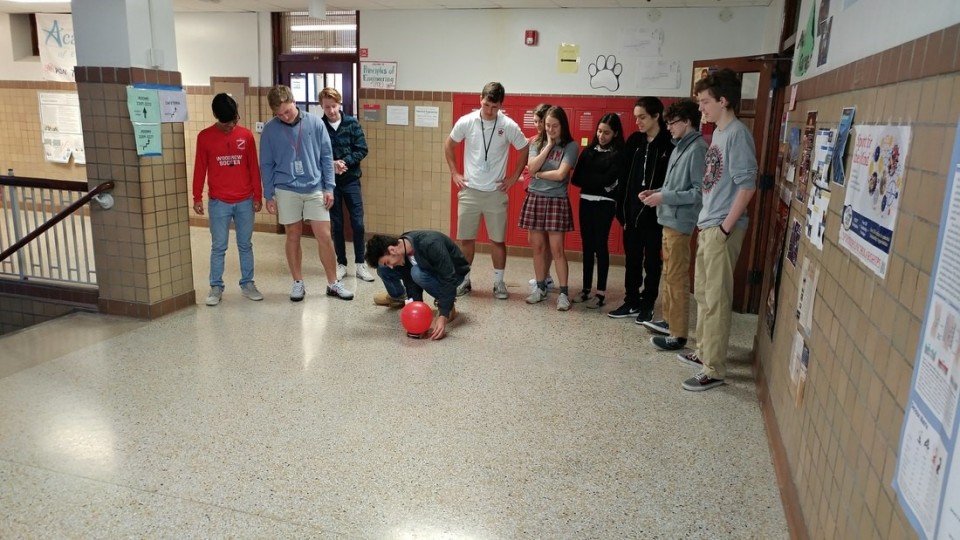
 The students were very impressed that some of the terminology and equations used in their class curriculum were used by Priscilla in her daily work as an MEP engineer. This direct connection between the concepts learned in class and the practical application by a "real-life" engineer are a great encouragement and motivation for the students in Mr. Carver's classes.
The students then put these concepts and theories to work, collaborating in teams to design a balloon race car out of foam core board, cardboard, dowels, and plastic straws. The greatest challenge was to maximize the thrust out of one or multiple straws to make their race car go the farthest. Additional photos can be found online here.
Water Resources with BGE Inc
Heidi Fischer of BGE Inc spoke to the Woodrow Wilson High School CE Club about her career in water resources engineering. She broke down the structure of water resources into three categories:
- Hydrology – how much water we have/get
- Drainage – where does all that water go?
- Hydraulics – how we move and control water through pipes and channels
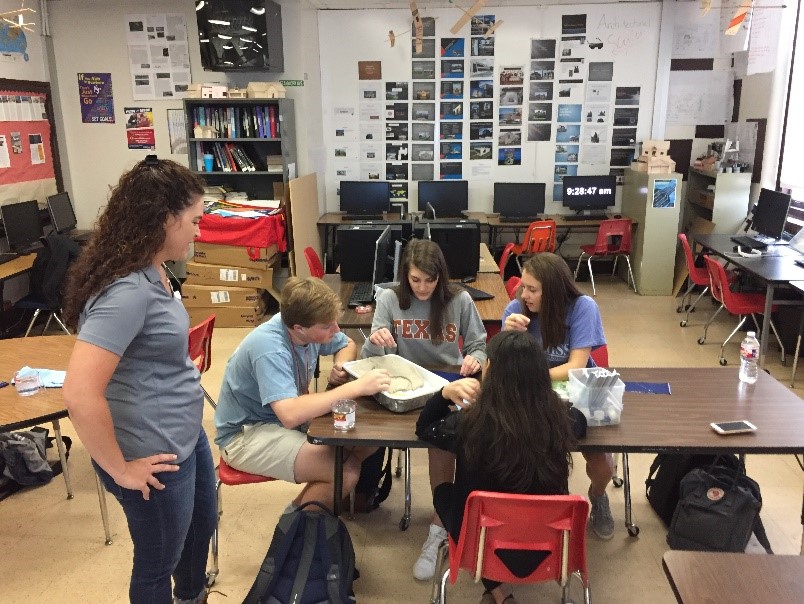
Heidi explained to the students that she makes floodplain impact studies to help other engineers know how high to build their bridges, help developers determine where they can construct new buildings, and help others develop erosion control methods. She took the students through a day in her life at work, which includes field visits, computer modeling, report writing, client meetings, design calculations, and RFI responses. As a practical example she showed the students some models and pictures fo the Crooks Branch Project she worked on for DART.
Finally, she challenged the students with a “build your own floodplain” activity where students were given a blank hill of clay along with tools and materials to make their own unique
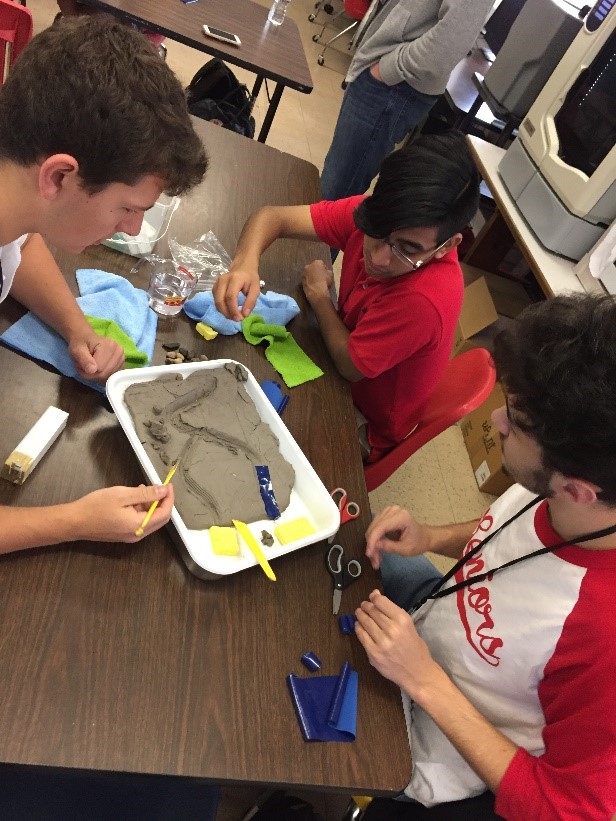
hillside with varying terrain, topography, and surfact textures. The students then poured water down the hillsides to see how the water flow was impacted. Additional photos can be found online here.
