Article Archives
- April 2026
- October 2025
- September 2025
- July 2025
- June 2025
- February 2025
- December 2024
- October 2024
- June 2024
- March 2024
- December 2023
- November 2023
- August 2023
- May 2023
- February 2023
- November 2022
- October 2022
- September 2022
- August 2022
- July 2022
- June 2022
- May 2022
- April 2022
- March 2022
- February 2022
- January 2022
- December 2021
- November 2021
- October 2021
- September 2021
- August 2021
- July 2021
- June 2021
- May 2021
- April 2021
- March 2021
- February 2021
- January 2021
- December 2020
- November 2020
- October 2020
- September 2020
- August 2020
- July 2020
- June 2020
- May 2020
- April 2020
- March 2020
- February 2020
- January 2020
- December 2019
- November 2019
- October 2019
- September 2019
- August 2019
- July 2019
- June 2019
- May 2019
- April 2019
- March 2019
- February 2019
- January 2019
- December 2018
- November 2018
- October 2018
- September 2018
- August 2018
- July 2018
- June 2018
- May 2018
- April 2018
- March 2018
- February 2018
- January 2018
- December 2017
- November 2017
- October 2017
- September 2017
- August 2017
- July 2017
- June 2017
- May 2017
- April 2017
- March 2017
- February 2017
- January 2017
- December 2016
- November 2016
- October 2016
- September 2016
- August 2016
- July 2016
- June 2016
- May 2016
- April 2016
- March 2016
- February 2016
- January 2016
- December 2015
- November 2015
- October 2015
- September 2015
- August 2015
- July 2015
- June 2015
- May 2015
- April 2015
- March 2015
- February 2015
- January 2015
- December 2014
- November 2014
- October 2014
- September 2014
- August 2014
- July 2014
- June 2014
- May 2014
- April 2014
- March 2014
- February 2014
- January 2014
- December 2013
- November 0019
- All Current Articles
Article Categories
- Announcement
- ASCE National
- ASCE Texas Section
- Awards
- Continuing Education
- E-Week
- Education Outreach
- Ethics Seminar
- Girl Scouts
- Institute Seminar
- Keynote Session
- Meeting Host
- Meeting Summary
- Membership Update
- President's Message
- Scholarships
- Technical Session
- Texas Section
- Volunteering
- Webinar
- Younger Members
- All Current Articles
Articles
CE Club April 2016 Update
Build-a-Beam with L.A. Fuess Partners

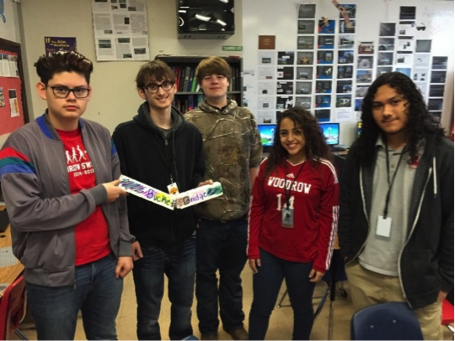
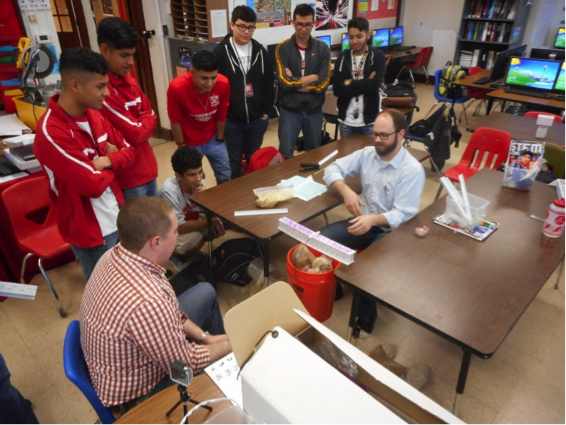
James Kleineck and Phillip Pesek from L.A. Fuess Partners put on the Build-A-Beam Challenge for the CE Club students, which was perfect given that they had just gone over a simple beam analysis problem the previous day. Each class was split into teams that were given six 2”x20” strips of foam core board to build a beam. They were also given hot glue guns and roofing nails to connect the foam core board pieces together. The teams were free to use the nails, hot glue, or both to build their beam section. Finally, the teams were informed that the ultimate goal of the Build-A-Beam Challenge was not to achieve the highest capacity but to achieve the highest efficiency by dividing the ultimate capacity of each team’s beam by the beam weight. This challenged the students to consider carefully the amount of materials used in their beam design. The beams were loaded to failure by hanging a paint bucket at mid-span and adding one and two pound increments of sand into the bucket. In the end, it wasn’t always the “strongest” beam that was the most efficient! James and Phil helped students during the design and construction phases of the project, offering advice on beam stiffening and section design. After testing, each beam was examined upon failure and the mentors explained the various failure modes. Additional pictures from the Build-A-Beam challenge can be found here and here. A video recap can also be seen here.
Water Resources Engineering with Kimley-Horn

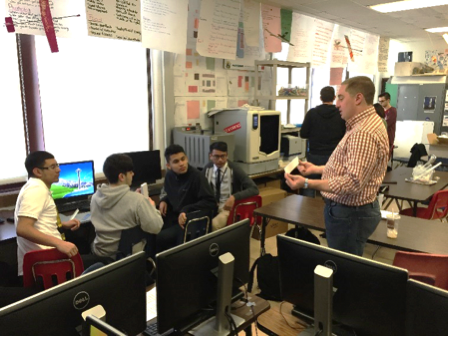
Troy Hotchkiss and William Weidman of Kimley-Horn Associates talked to the WWHS CE Club about the challenges faced by environmental engineers. The students had the unique opportunity to learn about a real-world project in Dallas: The Bachman Interceptor. The project revolved around an aging reinforced concrete sanitary sewer running underneath the Bachman Lake Dam and alongside the majority of the  lake. The existing pipeline was corroding, leaking, and had inadequate capacity for projected future growth in the area it was serving. A condition assessment was conducted to determine the extent of the pipeline replacement that would be required. Troy outlined many of the constraints and influences that he had to deal with while working on this project including: balancing public impact issues, the close proximity to Love Field Airport and Bachman Lake, very challenging underground conditions including high groundwater and unstable soils, overhead power lines, unknown private lines underground, and surrounding wetlands.
 The students were split into four groups with each group being given one of the four alternative routes that were given to the City of Dallas for the pipeline replacement. Each group had to then consider the routing criteria for the pipeline and fill out a criteria matrix that rated the importance level of each criteria item. These criteria items included cost, constructability, permitting, operations and maintenance, public inconvenience, and coordination with major stakeholders. Troy then showed the students the actual results from the coordination meetings that took place on the project. The students then had the opportunity to learn about and discuss why each criteria was given more weight or importance over others.
Finally, Troy discussed and showed pictures of the trenchless technology (microtunneling) that was used on the project in order to minimize the impact construction would have on the facilities and roads above ground.
