Article Archives
- April 2026
- October 2025
- September 2025
- July 2025
- June 2025
- February 2025
- December 2024
- October 2024
- June 2024
- March 2024
- December 2023
- November 2023
- August 2023
- May 2023
- February 2023
- November 2022
- October 2022
- September 2022
- August 2022
- July 2022
- June 2022
- May 2022
- April 2022
- March 2022
- February 2022
- January 2022
- December 2021
- November 2021
- October 2021
- September 2021
- August 2021
- July 2021
- June 2021
- May 2021
- April 2021
- March 2021
- February 2021
- January 2021
- December 2020
- November 2020
- October 2020
- September 2020
- August 2020
- July 2020
- June 2020
- May 2020
- April 2020
- March 2020
- February 2020
- January 2020
- December 2019
- November 2019
- October 2019
- September 2019
- August 2019
- July 2019
- June 2019
- May 2019
- April 2019
- March 2019
- February 2019
- January 2019
- December 2018
- November 2018
- October 2018
- September 2018
- August 2018
- July 2018
- June 2018
- May 2018
- April 2018
- March 2018
- February 2018
- January 2018
- December 2017
- November 2017
- October 2017
- September 2017
- August 2017
- July 2017
- June 2017
- May 2017
- April 2017
- March 2017
- February 2017
- January 2017
- December 2016
- November 2016
- October 2016
- September 2016
- August 2016
- July 2016
- June 2016
- May 2016
- April 2016
- March 2016
- February 2016
- January 2016
- December 2015
- November 2015
- October 2015
- September 2015
- August 2015
- July 2015
- June 2015
- May 2015
- April 2015
- March 2015
- February 2015
- January 2015
- December 2014
- November 2014
- October 2014
- September 2014
- August 2014
- July 2014
- June 2014
- May 2014
- April 2014
- March 2014
- February 2014
- January 2014
- December 2013
- November 0019
- All Current Articles
Article Categories
- Announcement
- ASCE National
- ASCE Texas Section
- Awards
- Continuing Education
- E-Week
- Education Outreach
- Ethics Seminar
- Girl Scouts
- Institute Seminar
- Keynote Session
- Meeting Host
- Meeting Summary
- Membership Update
- President's Message
- Scholarships
- Technical Session
- Texas Section
- Volunteering
- Webinar
- Younger Members
- All Current Articles
Articles
CE Club Update - May 2015
 Janet Yeow, Ismarie Torres, and Lina Sabeva from AECOM spoke to the CE Club about transportation engineering and challenged the students with a brief team design activity. Janet began the sessions by defining vertical and horizontal alignment and asking students to provide examples of vertical and horizontal curves they see on a daily basis on the roads and highways around their school and homes. The students learned about the superelevations that transportation engineers use on roadways and railways to make curves safe for travelers based on the size and speed limit of the roads or railroads. Using the example of a rollercoaster or a racetrack with banked curves helped students fully grasp this concept. The engineers then challenged the students to break out their pencils and calculators to work out a superelevation problem for train curves of differing radii. Ismarie then explained how transportation engineers calculate stopping sight distance on roadways using geometry and algebra. Once again, the students were asked to work out a problem, this time involving the stopping sight distance on a vertical curve on a road with a specific speed limit. Lina then explained why even flat, straight roads will be sloped to help with stormwater drainage. Lina also explained how engineers must balance design needs with cost restraints to create the most efficient design possible while still maintaining the safety of the people using the road or railway.
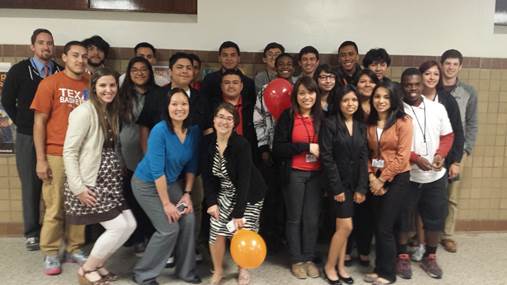
Finally, the students got the chance to design a balloon-propelled shuttle to transport pennies along a suspension line. The students came up with a variety of designs for the shuttle including baskets, sleeves, and envelopes connected to the balloon vehicle. Students had to deal with balancing the available thrust from the balloon with the weight of the pennies. Some teams attempted to transport too many pennies in their shuttle, resulting in little to no movement along the suspension line. Other teams had trouble keeping their shuttle attached to the balloon leading to the catastrophic loss of penny lives from the shuttle. Additional pictures from the AECOM presentations can be found here.

Sean Merrell, the ASCE Dallas Branch Past President (2013), visited Woodrow Wilson High School and gave a presentation on traffic engineering to Mr. Brandon Carver’s four civil engineering classes on the topic of traffic engineering. Sean talked about his path to becoming a traffic engineer from serving as a U.S. Army helicopter pilot, earning a bachelor’s and master’s degree from Texas A&M University, and working for BGE as well as the City of Frisco. Sean talked to the students about the importance of attending an ABET accredited university, gaining meaningful work experience, studying for and passing the professional engineering licensure exam, and completing continuing education as well as additional certifications. Sean was the perfect example of these final two steps within the traffic engineering industry since he holds PTOE and RAS certifications in addition to being a registered PE.
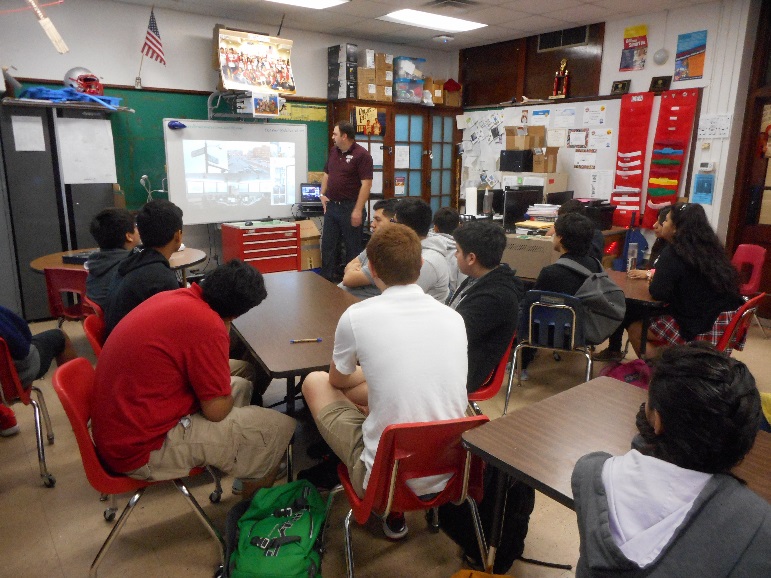
 Sean then asked the students to consider traffic signs and intersections that are all around us. Why is a stop sign a red octagon? Why is a railroad sign round? What’s the advantage of a roundabout? He explained that every single element of traffic engineering has a specific purpose and meaning. As practical examples, Sean showed the students traffic signal studies he had completed as well as plan drawings of roadway illumination projects and intersection design projects he has worked on throughout his career. He also showed the students a couple of the computer programs that traffic engineers use to work out signal timing and predict traffic patterns. The students especially enjoyed getting the chance to check out some of the equipment that is inside the traffic signal cabinets at major intersections.
